Cabinet · Case VIII — Trionfi
Tarot: From Card Game to Oracle
Forget the fortune-teller: for its first three hundred years, the tarot was simply the finest card game of the Italian Renaissance — the deck of dukes.
The tarot is the cabinet’s best example of how objects change meaning without changing shape. It was born as a gaming technology — an addition to the ordinary playing-card pack that created a permanent trump suit and a breathtaking set of picture cards. It was played, by that name and others (trionfi, then tarocchi), across Italy and then France and Germany, for three centuries. Only in the late 1700s did occultists reinvent it as a book of ancient Egyptian wisdom — which it never was — and only in the 1800s did the cartomantic deck, the one with the fortune-telling meanings, detach itself from the game entirely. Both histories are real; only one is ancient.
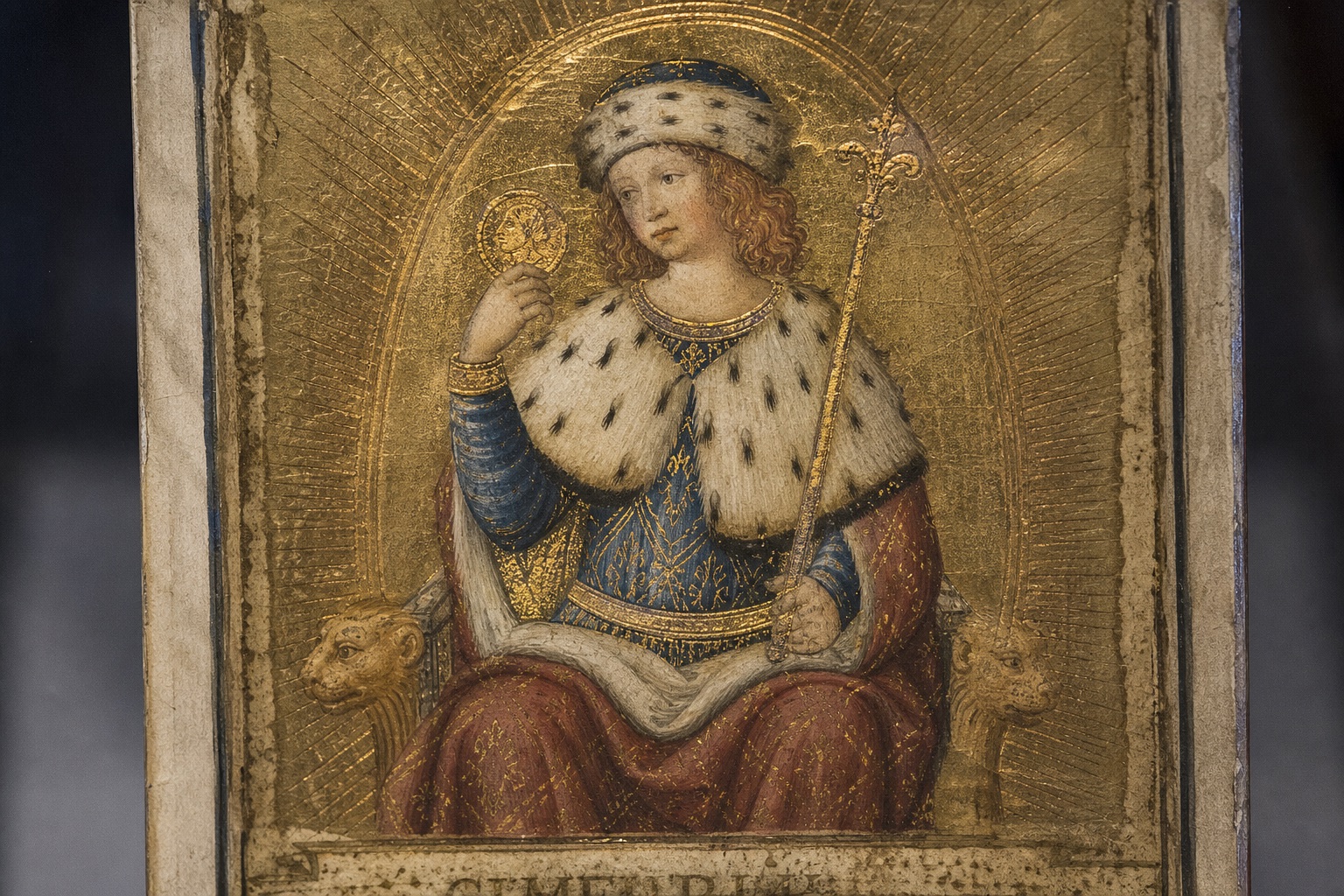
Milan, 1430s: the triumphs
The documentary trail begins in northern Italy in the 1430s–1450s: court account books from Milan and Ferrara record the commissioning of trionfi cards — “triumphs,” the word that gives us “trump.” The innovation was structural: to the standard 52-card pack, makers added a fifth suit of twenty-one numbered trumps (the Wheel of Fortune, the Hanged Man, Death, the Star, and so on) plus an unnumbered Fool. In play, trumps beat everything; the Fool beats nothing but escapes everything — a walking exemption. The surviving masterpieces of this first generation, the gilded Visconti-Sforza decks painted for the dukes of Milan, sit today in the Pierpont Morgan Library, the Accademia Carrara and the Bibliothèque nationale — see the museums drawer.
A game, not a gospel
Everything about the early tarot marks it as play. The trump series is not a mystical progression but a Renaissance parade — a trionfo was a street procession of allegorical floats, a spectacle every city staged, and the cards simply portable versions of it. The Church, which policed divination, left the cards alone for three centuries; preachers railed at dice and cards generally, but nobody accuses the tarot specifically of magic until the 18th century. Meanwhile the game spread and matured: tarocchi in Italy; tarot in France, where Marseille cardmakers standardized the iconography of the so-called Tarot de Marseille; elaborate central European variants with trumps numbering up to the fifties. From the game of dukes it became the game of everyone: by the 17th century, French tarot was a staple of provincial drawing rooms, played in forms still recognizable in the tarot played in France today.
| 1430s–50s | First trionfi decks commissioned in Milan and Ferrara; Visconti-Sforza cards survive. |
|---|---|
| 16th–17th c. | Game spreads as tarocchi/tarot; Tarot de Marseille iconography stabilizes; purely a card game. |
| 1781 | Court de Gébelin publishes the fantasy of an Egyptian “Book of Thoth” — the occult tarot is invented. |
| 1785 onward | Etteilla designs the first deck made expressly for fortune-telling; divination detaches from the game. |
| 1909 | The Rider–Waite–Smith deck, drawn by Pamela Colman Smith, becomes the visual grammar of modern cartomancy. |
The Egypt that never was
The transformation came from a book, not a game. In 1781 the French clergyman and antiquarian Antoine Court de Gébelin published a chapter asserting — on no evidence whatever, in an age wild about all things Egyptian — that the tarot concealed the lost wisdom of the Book of Thoth, carried out of Egypt by Gypsies (a people actually of Indian origin, as philology was already establishing). The claim was fantasy, but the timing was perfect: Enlightenment occultism, Egyptian mania after Napoleon’s expedition, and a printing trade ready to supply demand. Within a few years the Parisian hairdresser and card-reader Ettealla — Alliette reversed — had designed the first deck built for divination, with corrected numerological orders and printed meanings; professional cartomancy was born, and it never looked back.
Symbolism as sediment
The great irony is that the occultists preserved the game by misreading it. The 19th-century French occult revival — Eliphas Levi’s correspondences, the Kabbalah mapped onto the trumps, the Golden Dawn’s rites in Victorian London — loaded each card with layers of symbolism, and the artists of that movement produced the decks the world now thinks of as “the tarot”: most influentially the 1909 Rider–Waite–Smith deck, drawn by the theater designer Pamela Colman Smith, whose illustrated minor cards made every card a picture that could be read. Psychoanalytic culture then adopted the deck as a projective instrument — the psychologist Carl Jung’s archetypes made the cards respectable in a new key — and the counterculture of the 1960s–70s carried the result worldwide. None of this would have been possible had not a Milanese workshop, five centuries earlier, painted a splendid set of triumphs for a duke’s game.
The two tarots today
Both institutions survive side by side. The game is still genuinely played: French tarot, with its 78-card deck and its disciplined partnerships, remains one of France’s standard card games with clubs and federations; central Italian variants like minchiate survive in archives and revivals. The oracle, meanwhile, is a global visual culture of thousands of decks — an art form in itself, which this cabinet documents as a chapter in the history of how humans read chance: the same appetite that cast astragali in Egyptian tombs and asked the book of changes in China, seeking in a random draw a legible sentence. That wider story of divination-through-chance runs through the short history that opens this cabinet; the vocabulary — trump, spread, major arcana — is kept in the glossary; and the deck’s elder cousin, the plain playing card, waits in the cards drawer.