Cabinet · Case IV — The wheel
Roulette: The Little Wheel
A mathematical toy from Enlightenment Paris became the emblem of an entire industry — mostly because of one number a Frenchman dared to remove.
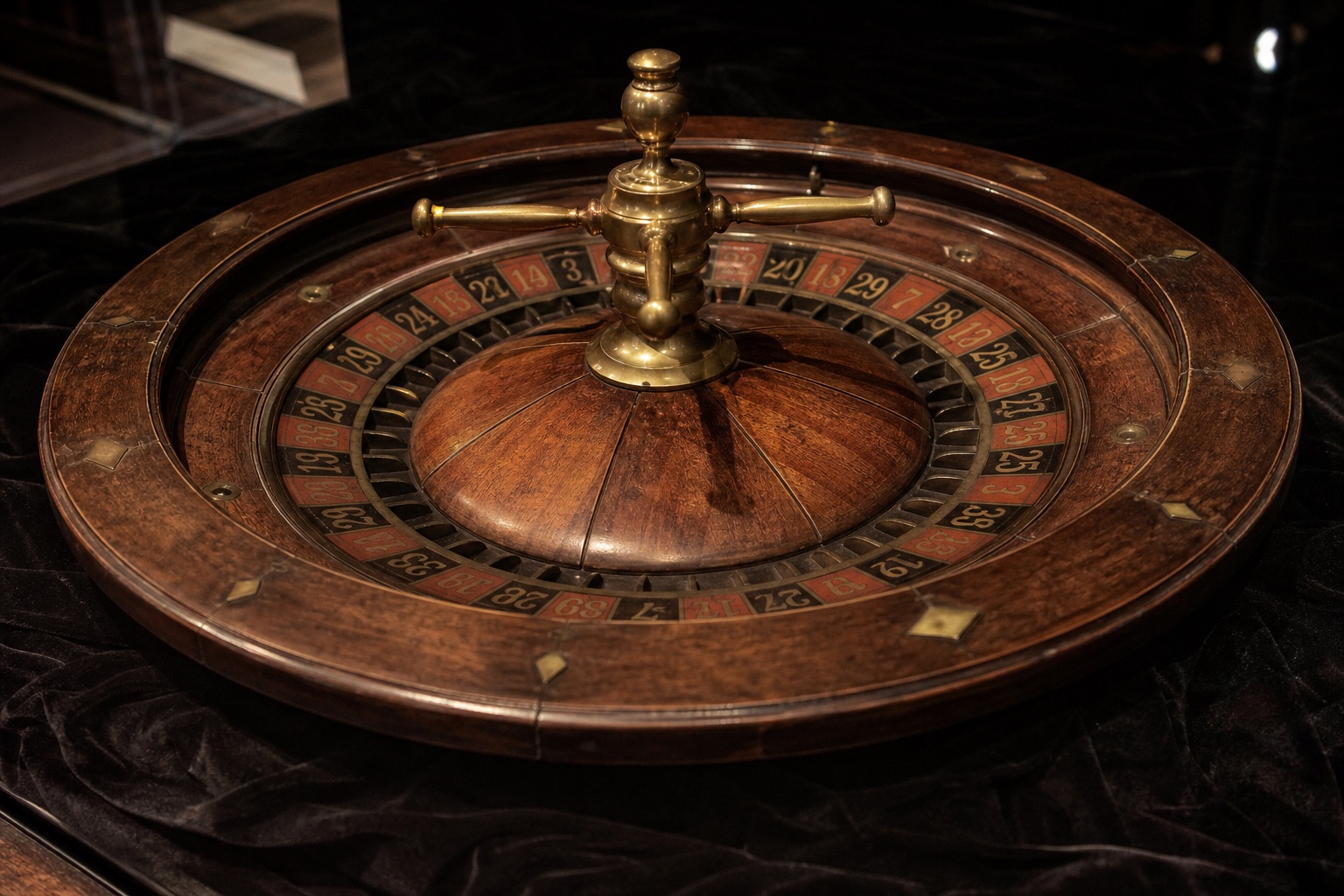
Of all the instruments in this cabinet, roulette is the youngest and the purest: a machine that does nothing but select a number. Its name is simply French for “little wheel,” and its ancestry is genuinely hybrid. Eighteenth-century France knew two competing devices — roulette, a wheel with pockets, and the Italian biribi board of numbered squares that the wheel gradually absorbed — and both were carnival and fairground amusements before they were casino games. What lifted the wheel out of the fairground was the Enlightenment habit of putting arithmetic inside amusements: an engineered wheel, a printed layout of odds, and a house that paid precisely less than probability demanded. The rest is logistics.
A legend about Pascal
The popular story credits Blaise Pascal with inventing roulette while trying to build a perpetual-motion machine in the 1650s. It is almost certainly false — Pascal was busy founding probability theory with Fermat at the time (see the pioneers drawer), and no source connects him to any wheel — but the legend is instructive anyway. It stuck because it should be true: roulette is exactly what a probability theorist would build, a machine whose entire aesthetic is the evenness of its chances. Every honest wheel is a theorem in lacquer and brass.
Paris, then Baden: the two wheels
The game as documented — wheel plus numbered layout, red and black, even-money payouts — is described in late-18th-century Paris and appears in the regulations and police reports of the Restoration and July Monarchy, when the Palais Royal’s gaming houses made it fashionable. The Paris wheel carried both a single zero and a double zero, giving the house its margin. The decisive mutation came not in Paris but in the little spa of Bad Homburg, where the brothers François and Louis Blanc, shrewd operators in a saturated market, removed the double zero in the 1840s. The single-zero wheel paid noticeably better odds; French players noticed; the casino filled. When German confederation law closed the spas in the 1860s, François Blanc was invited to a bankrupt seaside project in a tiny Mediterranean principality — and Monte-Carlo, as the timeline records, never looked back.
| Paris wheel | 36 numbers plus zero and double zero; house edge 5.26% on even-money bets. |
|---|---|
| Bad Homburg / Monte-Carlo wheel | 36 numbers plus a single zero; house edge 2.70% — the “European” wheel. |
| American wheel | Reverted to two zeros in the mining camps; the extra pocket crossed the ocean and stayed. |
| “En prison” | A French refinement: on zero, even-money bets are imprisoned for a second spin rather than lost — the edge shrinks again. |
The zero: a small idea with consequences
It is worth pausing on what the Blancs actually understood. A wheel with no zero would be, over time, a pure coin-toss between house and public — a business that cannot pay its croupiers. The zero is not a gadget; it is the entire business model compressed into one green pocket, the precise, measurable difference between the true odds of a number (36 to 1) and the price paid (35 to 1). This is the same structural insight that underlies lottery design and, writ formal, the “expected value” that probability theory learned to compute in the century before the wheel was built. The gambler bets on luck; the house bets on arithmetic; arithmetic does not lose.
Monte-Carlo and the age of the train
From the 1860s to 1914, Monte-Carlo became the most written-about place in Europe — a laboratory of luxury frequented by Russian grand dukes, bankrupt British lords and the newly rich of every nation the railway could reach. The casino fed literature: Dostoevsky’s The Gambler (written in 1866, before Monte-Carlo’s peak, under his own desperate Wiesbaden circumstances) set the type of the roulette obsessive, and the arts drawer follows the long shelf of novels the wheel inspired. It also fed science: the Monte-Carlo method — solving mathematics by simulated randomness — was named in the 1940s by scientists at Los Alamos who needed a code name redolent of chance, a nice closing of the circle between the casino and the mathematics it once embodied.
Engineers against the wheel
Because a wheel is a physical object, generations of players have concluded that physics — not luck — must govern it. In the late 1970s a group of graduate students at the University of California, Santa Cruz, later writing as the “Eudaemons,” hid a microcomputer in a shoe to time the ball and predict its landing sector; the episode, documented in Thomas Bass’s The Eudaemonic Pie, belongs in the cheating drawer less as fraud than as a philosophical experiment about where mechanics ends and chance begins. Casinos responded the way houses always do: better bowls, faster spins, and the humble rule that ends every system — the table limit. The wheel itself, a pocketed disc unchanged in principle since Paris, sailed on.
Why the wheel persists
Roulette survives because it is theater with a clean ending every thirty seconds: the rattle, the slowing click, the bounce, the number. No skill intervenes, no psychology, no opponent — which is precisely why, of all games, it became the emblem of pure fortune, the object novelists reach for when they need fate made visible. This cabinet keeps the wheel as a historical and cultural artifact; the mathematics of its margins belong to probability, its villains to cheating, its portraits to the arts, and its place in the long human affair with luck to the short history of games of chance.