Cabinet · Case III — The 52-card pack
The History of Playing Cards
A Chinese invention, an Egyptian refinement, a European obsession: the little rectangle of pasteboard is the most travelled object in the history of games.
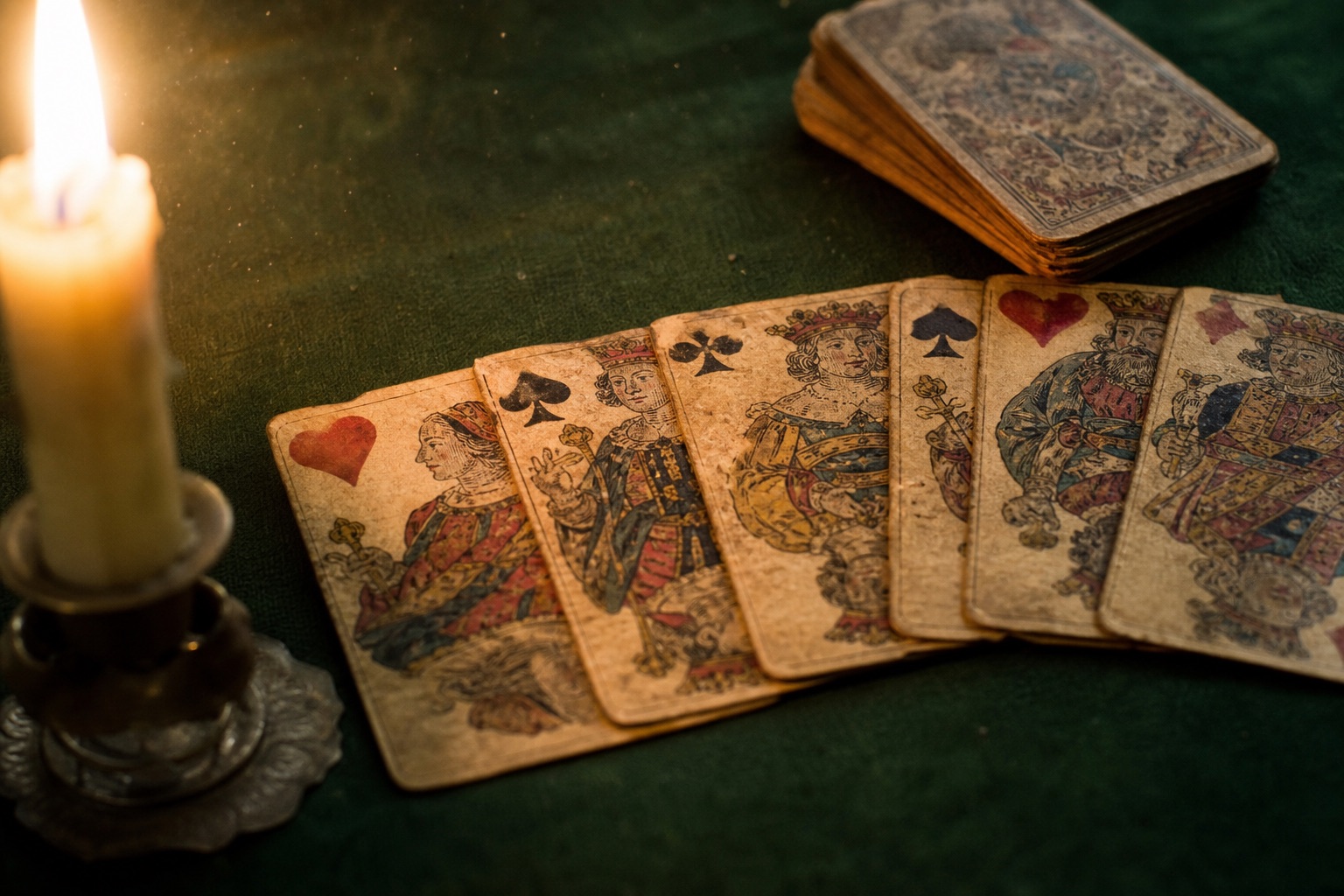
Dice are as old as metallurgy; cards are younger than the compass. Yet within a single century of their arrival in Europe — roughly 1370 to 1470 — playing cards had conquered every court and tavern from Seville to Kraków, driven the invention of tarot, provoked the first documented gambling regulations, and settled into the four suits that two-thirds of the planet still shuffles today. No other game technology has ever spread so far so fast.
East of everything: the leaf games
The paper trail begins in China, where paper itself began. Tang-dynasty references of the 9th century mention “leaf games” — sheets used in play — and the celebrated “thousand-leaf” decks of later Song and Ming sources, including money-suited cards whose suits were strings of coins. Playing cards, in other words, may literally have been money: some early decks seem to have circulated as tokens in stakes-games, and the suits encoded denominations of coinage. From China the idea radiated along the trade routes: Korean and Japanese variants appear (Japanese hanafuda cards descend from this family), and a fragment of what may be a paper card — the “Maza” fragment, hotly debated — hints at a passage through the Islamic world.
The Mamluk pack
The ancestor of the European deck is easiest to see in Egypt. Surviving cards from the Mamluk sultanate, 13th–15th century, form an almost complete 52-card pack: four suits — cups, coins, swords and polo-sticks — each running from ace to ten plus three court cards. Islamic art’s prohibition of figures made the courts abstract: the malik (king), nā’ib (deputy) and thānī nā’ib (second deputy) were named but drawn as ornamental inscriptions. When the pack crossed the Mediterranean, Venetian and Catalan hands reshaped the abstract courts into kings, riders and pages — and the polo-stick, a sport no European had seen, quietly became the baton that would harden into the club.
1377: the year of the cards
Cards enter European documents all at once, like a rumour. A Swiss monk notes their arrival in 1367; in 1377 a friar of Basle, Johannes von Rheinfelden, writes a whole treatise describing the new game, its suits, its moral dangers and its variants; that same year Barcelona’s authorities legislate against naips; Florence’s city council soon follows. Within a decade, card-painters form guilds in Germany, and Ulm and Augsburg become early centres of woodblock printing for cards — making playing cards, by a whisker, one of the first mass-market products of the print revolution, contemporary with Gutenberg and vastly more widely owned.
| Latin suits | Cups, coins, swords, clubs — the direct Mamluk inheritance of Italy and Spain. |
|---|---|
| German suits | Hearts, bells, leaves, acorns — the 15th-century local invention of the print centres. |
| French suits | Hearts, tiles, clovers, pikes — rationalized c. 1480; cheap to print, they became global. |
| “Spades” | From Italian spade, swords; “clubs” from Spanish basto; the English names are a museum of translation. |
The French solution
Rouen and Lyon printers simplified the German ideas into the suits the world now uses, splitting each pip symbol into red or black shapes that could be stamped from two blocks in seconds. The queen entered the court (Latin packs had pages; French packs promoted a dame), and the ace — humble or mighty depending on the game — acquired in France the ornate device it still carries. From the 16th century onward, French cards were exported in such volume that in English the pasteboard itself kept the French name: carte.
Card games as a laboratory
Every arrival of cards bred new games the way a new instrument breeds music. Fifteenth-century Italy produced trionfi — triumphs, the trick-taking principle with a permanent trump suit — which became tarot, and separately the family of games that led to whist, then bridge. Spain’s primero and France’s poque (via the Mississippi riverboats, poker) descend from the same vital stock; baccara bubbled up in Italian and French courts; faro, the darling of the 19th-century American saloon, came from pharaon, a French game named — for reasons lost — after an Egyptian king. The vocabulary of all these games is kept in the glossary.
The backs, the joker, the corner index
Three small inventions completed the modern card. Reversible court figures (19th century) ended the nuisance of reading a king upside down. Corner indices — the tiny pips in the upper-left corner, popularized by American printers after the Civil War — made the fanned hand possible and with it the whole grammar of tight play. And the joker was born in the 1860s for the American game of euchre, an immigrant like the rest of the pack. Meanwhile card backs, plain for centuries, became advertising space, portraiture and art — and marked backs became the cheat’s classic tool, as catalogued in the natural history of cheating.
Cards in the culture
Because everyone owned cards, everyone painted them: Caravaggio’s cardsharps, Georges de La Tour’s fortune-tellers, Cézanne’s silent peasants, each generation finding in the deal a mirror of its morals. The arts drawer follows that reflection; the museums drawer lists where the oldest surviving packs are kept, from the Cloisters’ Mamluk cards in New York to the thousand-deck cabinets of Paris and Dresden. And for the larger story into which cards arrive so loudly — the whole human affair with luck — return to the short history of games of chance.