Cabinet · Case XIII — The traveller’s drawer
Where to See Game History
The objects in this cabinet have addresses. This drawer maps the real museums where the world’s oldest boards, cards and dice can be visited — no ticket to Monte-Carlo required.
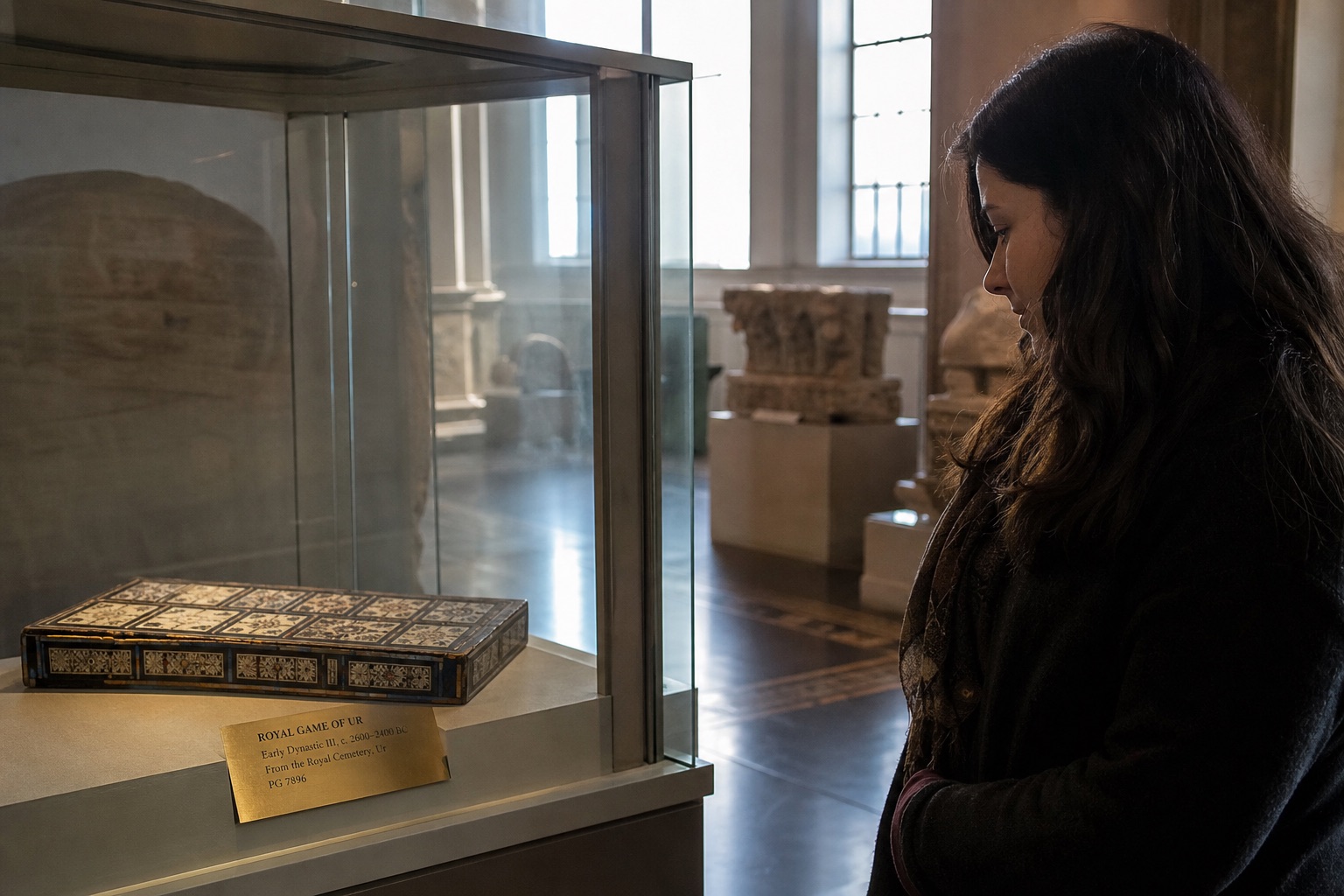
Reading about the Royal Game of Ur is one thing; standing in front of the lapis-and-shell board while a screen beside it plays the game with its decoded rules is another. Material culture is the backbone of game history — most of what this archive relates was learned from objects dug out of graves, salvaged from shipwrecks, or kept by collector-curators who hoarded pasteboard the way others hoarded paintings. Here is where to find them. (Collections and displays change; check each museum’s current galleries before travelling — this drawer records holdings, not exhibition guarantees.)
London: the British Museum
The deepest single mine. The Royal Cemetery of Ur excavations were jointly funded, so the great game boards split between London and Philadelphia; the British Museum’s share shares a gallery with the cuneiform tablet of Itti-Marduk-balatu — the world’s oldest written game rules — so that board and rulebook reunite in one room. The Egyptian collection carries senet boards and the tomb assemblages that made Egypt’s game-and-afterlife link visible; the Greek and Roman rooms hold astragali, dice, and game tables incised in stone; the famous Lewis chessmen sit nearby for the contrast case — the game of reason beside the games of fate.
La Tour-de-Peilz: the Swiss Museum of Games
A whole medieval castle on Lake Geneva devoted to play — the only national-scale museum of its kind. The Château de La Tour-de-Peilz opened its Musée Suisse du Jeu in 1987 and surveys the entire field: ancient replicas and originals, European and Asian playing cards, tables and backgammon boards through the centuries, tarot decks from Marseille to occult revivals, chess sets across continents, and rotating exhibitions on everything from mahjong to video games. For a visitor wanting the whole history of the cabinet in one afternoon, this is the address.
| British Museum, London | Ur boards, rules tablet, senet, dice, Lewis chessmen. |
|---|---|
| Penn Museum, Philadelphia | The second Ur board and the Mesopotamian gaming finds. |
| Swiss Museum of Games, La Tour-de-Peilz | Castle entirely devoted to games; global survey collection. |
| The Metropolitan Museum of Art, New York | Playing cards in the drawings and prints collections; the Cloisters holds Mamluk-era cards. |
| Egyptian Museum, Cairo | Tutankhamun’s senet boards and tomb gaming equipment. |
| Bibliothèque nationale / Morgan Library | Illuminated Visconti-Sforza tarocchi cards (Paris, New York). |
Philadelphia: the Penn Museum
The University of Pennsylvania’s museum of archaeology holds the other half of Ur’s gaming treasure — board fragments and pieces from Woolley’s expedition displayed with the cemetery’s context. Together with London it makes the point this cabinet keeps returning to: the oldest confirmed board game on Earth is known from two museums, one dig, and a handful of royal graves. Check current gallery status; the Mesopotamian galleries have seen rotations.
New York: the Met and the Cloisters
Playing cards entered art museums as “popular prints,” which is lucky for their survival. The Metropolitan holds sheets and packs across its prints collection, and the Cloisters — the Met’s medieval branch — preserves one of the world’s treasures of card history: the group of near-complete Mamluk cards found in Istanbul, the closest surviving relatives of the European pack (see the cards drawer). Combined with the Met’s chessmen and game-playing scenes in painting, a day in Upper Manhattan covers a surprising stretch of the cabinet.
Cairo and the Nile
The Egyptian Museum holds the senet boards buried with Tutankhamun — four of them — alongside the gaming equipment of other New Kingdom tombs; provincial collections from Luxor to Tanis carry senet boards, throwing sticks and astragali sets by the drawerful. Egypt is the only country where the afterlife-and-gaming link can be walked, room after room.
The card cabinets of Europe
For the scholar or the simply curious, the great libraries hold the paper heritage: the Bibliothèque nationale de France’s cabinet des estampes, the Germanisches Nationalmuseum in Nuremberg, and the Morgan Library in New York, whose Visconti-Sforza tarocchi cards (Milan, mid-1400s) are the Sistine ceiling of tarot history — gold ground, ducal arms, the trumps of the original game. Nuremberg, an early printing center of cards, is a fitting place to see the woodblock era; Dresden’s Kupferstich-Kabinett and Paris keep the engraved French packs that fixed the world’s suits. Smaller specialist museums — from the former playing-card museum of Issy-les-Moulineaux near Paris to provincial chess and toy museums — rotate deep holdings; a search for “playing card museum” plus a city rewards the traveller.
How to travel with this drawer
A practical closing note: game history is usually displayed inside larger museums, so plan around their strong rooms rather than dedicated wings — Mesopotamia for Ur, Egypt for senet, prints for cards, the Islamic galleries for the Mamluk pack. The timeline pairs well with this drawer as a pre-departure syllabus; the dice, cards, backgammon and tarot drawers explain what you will be looking at; and the whole story the objects tell is stitched together in the short history of games of chance that opens this cabinet.