Cabinet · Case II — Randomizers
Ancient Dice & Knucklebones
Before humanity manufactured randomness, it harvested it: the knucklebone of a sheep was the first die, and it was already ancient when the pyramids were young.
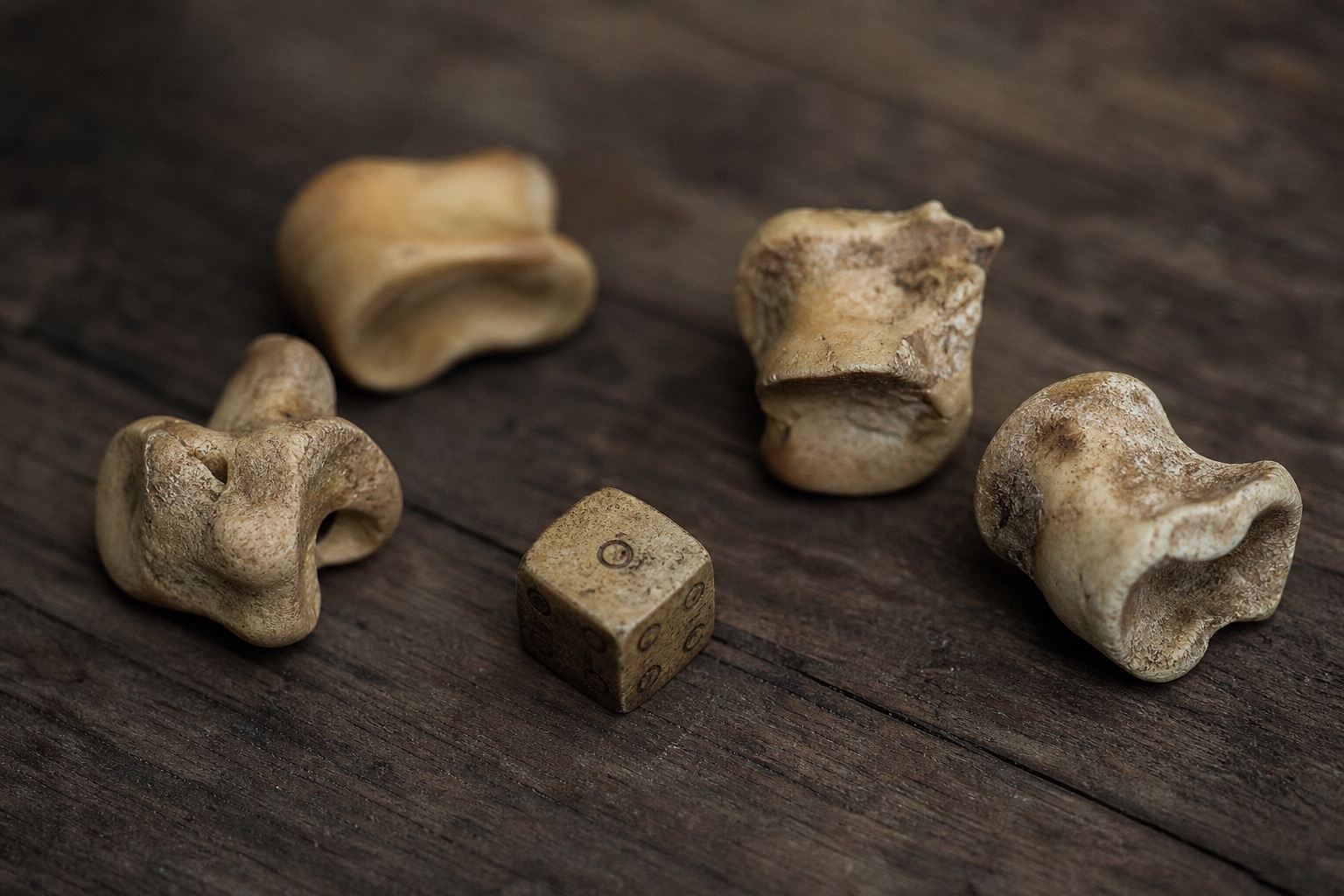
The archaeological record of gaming begins with a small, irregular bone. The astragalus — the ankle bone of a sheep, goat or ox — tumbles in a way no hand can control, and lands with reasonable consistency on one of four sides. Long before anyone carved a numbered cube, gamblers and priests alike cast these bones and read the result. Egyptian tombs from the third millennium BCE contain them by the handful; a royal grave at Ur yielded a set running on lapis-lazuli trim; Greek youths played games of skill with them that Aristophanes jokes about; Roman legions carried them to the farthest frontier, and Roman law fined the casting of dice in public — unless it was done, the jurists added with a straight face, at the Saturnalia, when everything was permitted.
Why the bone, then the cube
An astragalus is biased: its faces are not equally likely, a fact ancient gamblers surely sensed even without notation. The cubical die — six equal faces, pips from one to six, opposite faces summing to seven — is a deliberate act of engineering that appears independently in the Indus Valley, Mesopotamia and Egypt by the third millennium BCE. The standardization is remarkable: a die excavated in Pakistan and one from a Roman villa in Gaul may differ in material but not in geometry. Someone, somewhere, had understood that fairness of shape was fairness of play.
| Astragali sets | Egyptian tombs, c. 3000–2000 BCE — buried with the dead for luck in the afterlife. |
|---|---|
| Semitic & Indus dice | Cubical dice, 3rd millennium BCE — bone, ivory, terracotta; pips drilled and inlaid. |
| Dice tower of Vettweiss | Roman Germany, 4th c. CE — a tapered tower with steps and bells to guarantee a fair tumble. |
| Loaded Roman dice | Several surviving cubes weighted with mercury or iron cores; see the cheating drawer. |
| Viking dice | Whalebone and antler dice from Hedeby and York; asymmetric examples hotly debated by archaeologists. |
The dice of the gods
Not all casting was play. Sortition — decision by lot — ran the Athenian democracy: most public offices were filled by drawing from a kleroterion, a stone slab with slots for citizens’ tokens, specifically so that no man could claim power by merit or money. The Hebrew scriptures cast lots to divide the land and to expose guilt; the Romans read the sortes for state business; the Chinese used stalks and dice in divination that flowed into the larger family of Asian games. The same instrument served temple and tavern, and the boundary between the two was often blurred: to gamble was, in a weakened sense, to ask the gods a question.
Rolling sticks and split reeds
Dice were not the only way to make a number. Egyptian senet used four two-sided throwing sticks; the Royal Game of Ur used tetrahedral dice — four-sided pyramids, of which only the marked point counted; Indian games of the pachisi family threw cowrie shells, whose mouth-up or mouth-down gave binary outcomes with a satisfying rattle; Native American peoples of the Plains and Woodlands split reeds or bone for the same purpose, and the Aztec patolli threw whole beans painted with dots. Every culture seems to have found its own disposable randomness.
The Roman world of alea
Rome gambled on a scale that would impress any modern regulator, and left the paperwork. Dice were common enough that Plautus puts them in comedies; the Emperor Claudius wrote a history of the game and played in his carriage, fitted with a board so the shaking of the road rolled the dice for him; and the aleator — the professional dice-player — was a recognized social type. Latin gave the world its enduring metaphor: alea iacta est, “the die is cast,” the sentence Caesar pronounced (if Suetonius can be trusted) at the Rubicon, borrowing the gambler’s voice for the point of no return.
Medieval and modern descendants
Dice never lost their throne. Medieval Europe played hazard — from the Arabic al-zahr, “the die,” a word that survives in English both as “hazard” and, by way of Old French, in the game of craps descended from it. The Church banned dice for clergy and laity alike, with entirely partial success; dice turn up in the edges of cathedral carvings, in the pockets of drowned sailors, and in the margins of manuscript cautionary tales. When playing cards arrived in the 14th century they joined dice rather than replaced them, and when Blaise Pascal wanted a problem worthy of Pierre de Fermat in 1654, he chose a dice-and-stakes question — the moment recounted in the probability drawer where the knucklebone finally met the theorem.
What the bones remember
Modern archaeology has added a statistical coda. Studies measuring hundreds of Roman dice have shown that many were visibly non-cubic, and that pip conventions changed over time — evidence that “fairness” is a historical invention, refined slowly over millennia. The dice that survive in museums, each with its biography of hands and losses, are gathered in the museums drawer of this cabinet. For the vocabulary of all this — astragalus, sortition, hazard — the glossary keeps the definitions; for the grand narrative that dice open, return to the short history of chance.